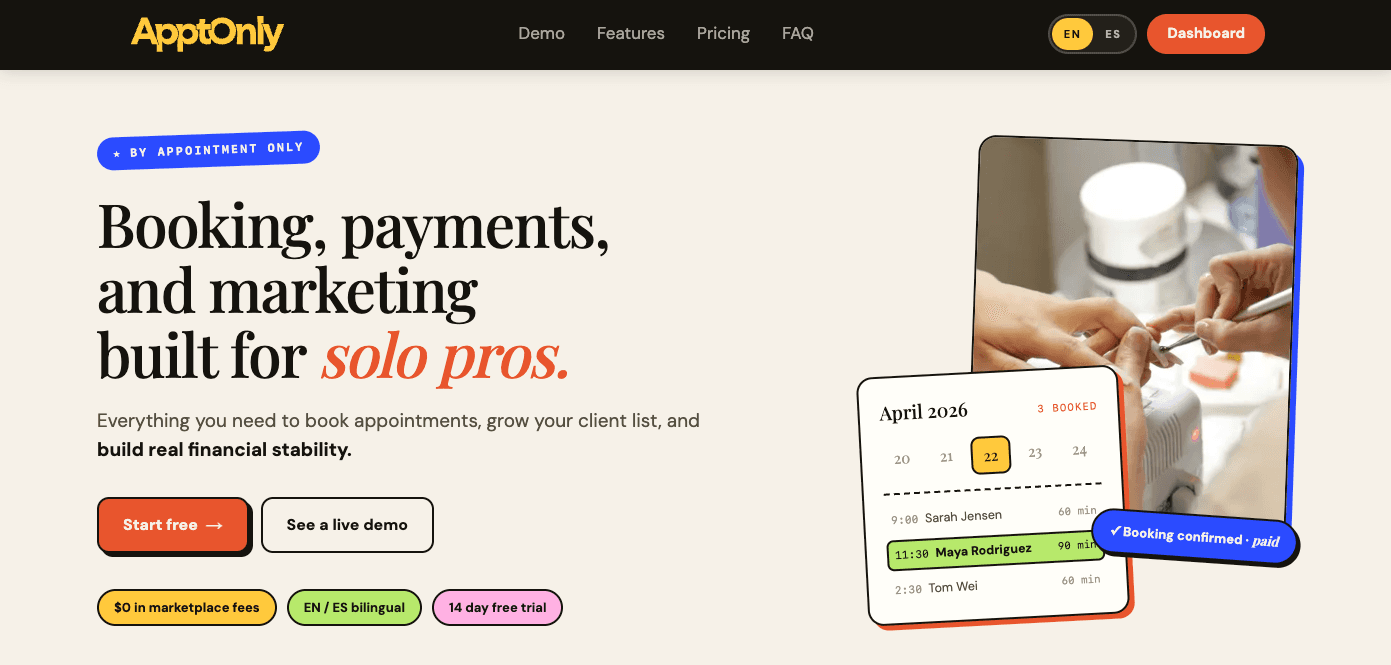
The Booking Software for Solo Massage Therapists That I Wish Existed (So I Built It)
A solo developer's story of ditching marketplace booking fees and building ApptOnly - booking software for massage therapists, nail techs, and solo pros.
Well, hello again. It's been a minute since I wrote anything here that wasn't about Cursor, Claude, or some shiny new coding agent. But I'd rather build things than write about building things, so it takes an actual story to drag me back here, and this time I've got one. This time I pointed the AI tooling I usually write about at something of my own and shipped a real product with it.
The short version: I got annoyed. The longer version is about marketplace fees, 20+ years of building software, and a question I can't stop chewing on about which other industries might be sitting ducks as software development keeps changing.
The marketplace fee that broke me
My fiancée runs a small wellness practice, and like most practices, we used a booking platform to handle scheduling and payments. We started out on a service called MassageBook, which is a dominant player in the massage niche and, to be fair, does a LOT right.
But the model has a catch I couldn't unsee once I saw it: the marketplace. Your booking page lives inside their directory, alongside every other therapist in your zip code. When a client finds you through that marketplace, you pay a cut. And the whole thing quietly nudges your clients, the ones you earned, toward a listing where your competitors are one tap away.
I kept thinking about what I was actually paying for. A monthly fee, plus payment processing, plus a commission, for the privilege of having my own clients shown a menu of other people they could book instead. That's not a tool working for me. That's a tool renting me access to an audience I already built.
I'm not here to dunk on MassageBook. The marketplace model makes total sense for MassageBook, and for plenty of their customers. It just doesn't make sense for the solo practitioner paying into it. That gap, between what the software optimizes for and what the person using it actually needs, is the whole reason ApptOnly exists.
The problem was bigger than my annoyance
Once I started looking, the annoyance turned into a market study.
Most booking platforms in this space (MassageBook, Vagaro, Fresha, Mindbody) are built for businesses with multiple staff. Teams. Front desks. Different rooms. But roughly 73% of massage therapists in the U.S. are sole practitioners. No staff, no front desk, no team. They're being sold software designed for a business they don't run, and charged for features they'll never use.
Some problems hit the solo operator a lot harder than they hit a bigger business. A massage therapist physically cannot answer the phone mid-session, because their hands are, you know, occupied. Their sessions are long, so a single no-show can wipe out a quarter of the day's income. Many of them work in Spanish, or serve Spanish-speaking clients, and not one major platform offers a genuine bilingual experience. These aren't edge cases. They're the center of the market, and they're underserved.
So the opportunity wasn't "make a slightly nicer MassageBook." It was "build the thing that should have existed for solo practitioners all along."
Why I figured I could actually pull this off
I've been making software for a long time. Long enough to have watched a few technology bubbles inflate and pop. Long enough that I've shipped more apps than I can cleanly remember. I know how the pieces fit together, what scales, what breaks, and what's worth not building in the first place.
But experience alone wasn't the advantage. The advantage was that I'm living the problem. Our practice, Body Balance by Marybel, became the pilot site. Every product decision got pressure-tested against a real, operating massage business instead of a persona in a slide deck. When I wondered whether a therapist would actually use something, I didn't have to guess. I could walk into the other room and ask.
The best vertical software almost always comes from someone who lived the problem first. I just happened to be a software guy who's marrying into the exact problem I wanted to solve.
How AI accelerated the build, and what it didn't do
Now for the part everyone wants to hear about, since I usually write about AI-assisted development here anyway.
Yes, AI made this dramatically faster. A solo founder building a full SaaS booking platform, with payments, intake forms, automated reminders, a white-label client-facing site, and a bilingual interface, would have been a year-plus slog a few years ago. With AI in the loop, I compressed enormous chunks of that. Scaffolding, boilerplate, the tedious 80% that used to eat weeks. It's a genuinely thrilling time to be building.
But here's the honest part, and it's the same point I made when I wrote about vibe coding: AI collapsed the time, not the judgment.
Every decision that actually makes ApptOnly good came from experience, not a prompt:
- Killing the marketplace entirely. The single most important product decision was a subtraction. No AI suggested that. It came from being on the wrong end of the fee.
- Bilingual EN/ES as a foundation, not a toggle. Most platforms bolt on a language switch. We designed for Spanish-speaking practitioners from the first screen, because I could see who was being ignored.
- Cutting features that sounded great but weren't feasible. When we scoped the financial tools, AI was happy to help me design a system that moved money between accounts. Domain knowledge is what told me that originating those transfers drops you into money-transmitter licensing: surety bonds, federal exposure, the works. So we architected around it. The software reads, calculates, and prompts, but never touches the money. That's a call you make from scars, not from autocomplete.
AI is the best junior developer I've ever worked with. Fast, tireless, never complains about indentation. But it doesn't know which thing is worth building, and it doesn't know what it's like to pay a commission on a client you brought in yourself. That part's still the human's job, and honestly, that's where 20+ years of doing this earns its keep.
What makes ApptOnly actually better
Stripped down, ApptOnly wins on a handful of things the incumbents structurally can't or won't match:
- No marketplace, no commissions. Your clients are yours. You keep 100% of what you earn from them. There's no directory quietly showing them your competition.
- Built for one, not for a team. No paying for multi-staff scheduling, payroll, or inventory you'll never open.
- Genuinely bilingual. Onboarding, dashboard, and the client-facing booking page, all in English and Spanish.
- No client app download. Your clients book from a link. No account to create, no app to install, which matters a lot when your clientele skews older or less techy.
- Your brand, not ours. White-label from day one. The booking page is yours, not an ad for the platform.
- Built for the work, by profession. Intake forms, client history, and preference sets are native, and they go beyond massage. A nail tech tracks color and shape preferences. A hairstylist tracks formulas and past services. A massage therapist tracks pressure and problem areas. Same engine, tuned per trade, instead of a generic notes field everyone has to bend to fit.
None of these are flashy. They're just right for the actual user, which turns out to be most of the battle.
Wait, is this only for massage therapists?
Fair question, since I keep saying "massage." Short answer: no.
ApptOnly started in massage therapy because that's the problem I live, and starting narrow is how you build something that actually fits instead of something vaguely OK for everyone. But the core need is shared across a huge range of trades: a solo professional who books one-on-one appointments and wants to own their client relationship.
Nail techs. Hairstylists. Estheticians and facialists. Lash artists. Body sculpting and lymphatic drainage pros. Mobile and in-home providers of every kind. Anyone running a one-person, appointment-based practice hits the same walls. Software built for teams they don't have, marketplace fees on clients they earned, and a booking experience that demands an app download nobody wants.
That's why the preference sets are built per profession rather than hardcoded for massage. The platform speaks each trade's language. If you book clients one at a time and your name is the brand, ApptOnly is built for you.
The question I can't stop asking
Here's where my brain went after all this, and it's the real reason I sat down to write.
If a solo developer with domain knowledge and a stack of AI tools can build a better product than the dominant player in a niche, in evenings, around a day job, then how many other industries are sitting on the same setup?
Think about the pattern. A big, established incumbent. Pricing that's crept upward year over year. A product that's bloated for the average user because it's chasing the enterprise account. Fees that feel less like a price and more like a toll. A customer base that's loyal mostly because switching is a pain, not because they're happy.
That describes a lot of software. Probably some you use today and quietly resent.
What's changed isn't that incumbents got worse. It's that the cost of building a focused, modern alternative has collapsed. The moat used to be the sheer effort of building, and AI drained a good deal of that moat. What's left as a real advantage is the thing AI can't give you: knowing the customer cold, and having the judgment to build the right thing instead of everything.
I don't think ApptOnly is a one-off. I think it's an early example of a pattern that's about to play out across a lot of overlooked verticals. The opening belongs to people who actually understand a specific customer's pain, not to the biggest team or the deepest pockets.
Which industry would you try to disrupt if you had the chance? I've got a short list of my own, but I'd rather hear yours. Drop it in the comments.
And if you're a massage therapist, nail tech, hairstylist, esthetician, or anyone who books clients one at a time and is tired of paying to reach the clients you already earned, that's literally why this exists. Come take a look at ApptOnly.
A few quick questions people have asked
What is ApptOnly? A booking platform built for solo practitioners who run on one-on-one appointments: massage therapists, nail techs, hairstylists, estheticians, lash artists, and other independent wellness and beauty pros. It includes branded booking pages, profession-specific intake and preference forms, automated reminders, payments, and a bilingual EN/ES experience, with no marketplace commissions and no required client app download.
Is ApptOnly only for massage therapists? No. It started in massage therapy because that's the founder's own practice, but it's built for any solo professional who books appointments and owns their client relationship. Preference and intake forms are tuned per profession: color and shape for nail techs, formulas for stylists, pressure and focus areas for massage therapists.
How is it different from the established booking platforms? ApptOnly has no marketplace, so there's no commission on your own clients and no directory exposing them to competitors. It's built for one-person practices instead of multi-staff spas and salons, it's genuinely bilingual, and it's white-label, so it's your brand on the booking page, not the platform's.